|
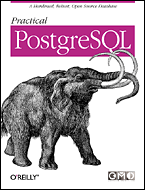
As the cover text of this book suggests, Postgresql is indeed a "hardened, robust, Open Source database," packed with many features that rival some of the big names in proprietary database systems. Practical Postgresql, by Command Prompt, Inc. provides an excellent introduction to Postgresql for both newbies, and intermediate users. Advanced users might not need most of the introductory material, but the reference material included throughout the book is very useful for almost any Postgresql user.
The book begins with a chapter providing an overview of Popstgresql and its capabilities and then continues with the obligatory chapter on downloading and installing Postgresql. The steps are fairly simple to follow if you're unaccustomed to such activities, and the authors are careful to offer many tips to help you in the process.
Following this begins a good tutorial on SQL, specific to Postgresql, which spans several chapters. It builds from the ground up, so if you've never used SQL before, this book provides a good introduction to that topic. It covers the standard SQL topics including the various types of queries, join types, data types, vnd iews.
This introduction to SQL continues with coverage of all the operators and functions available in Postgresql, providing a very good reference for these topics. For each function covered basic usage, a description, and an example is provided. Continuing, the book discusses the different client interfaces for working with Postgresql, specifically the command-line psql and the graphical Tcl/Tk-based Postgresql Access.
The next section of the book covers basic database administration including discussion of authentication and encryption, basic database tasks such as starting and stopping the database, creating databases, and backup and recovery procedures. This section also covers user and group management. The coverage is very thorough, including discussion of the important configuration files. Full lists of options for the different commands are given along with helpful descriptions and examples.
The last section of the book covers various programming topics, including a very good tutorial for PL/pgSQL, Postgresql's procedural language, which is simlar to Oracle's PL/SQL. This section also includes a chapter dedicated to Postgresql programming with Java via ODBC, and a chapter which covers the proprietary LXP application server which is distributed by the authors of the book. Finishing up the book is a very useful SQL command reference.
One thing I like very much about the book is the clear way in which command syntax is presented. Throughout the book, as new commands and tools are introduced, a full syntax diagram is displayed (or a full command-line option list), and then a clear explanation about each part of that syntax is given. In most cases an example then follows of the usage of that particular command or tool. Also very nice, is that most of the reference information about the SQL commands is then given again, all bundled together, but a bit more concisely in the reference at the end of the book. So the book serves very well as both a tutorial and a reference.
Although the book is very thorough, it isn't exhaustive. Two areas that I wish had been covered (but which I wouldn't be surprised to see in future editions) are rules, and user-defined data types. Also missing is in-depth coverage of some of the unique data types Postgresql provides such as network data types.
Overall rating: 9/10
This book is also freely available online from Command Prompt, Inc., as a "constantly developed version."
|