|
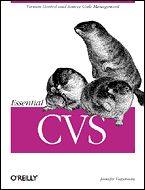
Essential CVS
Author: Jennifer Vesperman
Pages: 320
Publisher: O'Reilly & Associates
ISBN: 0-596-00459-1
Summary: A very useful, (but sometimes dry) CVS tutorial/reference.
Review Date: 18 Oct, 2003
|
I always wondered when O'Reilly would do a book on CVS. It seemed to be a major hole in their span of topics and being such a commonly used tool in the open-source community the absence was somewhat puzzling. But now the gap has been filled with Jennifer Vesperman's Essential CVS.
CVS is an open-source version control system used the world over for managing changes to software source code, configuration files, and can be used in many circumstances where differences in file content need to be tracked from change to change.
The first section of Essential CVS begins with a chapter introducing the concepts behind CVS and describes the various manners in which CVS is used. Following this is a quickstart guide to CVS that gives a fast 'high-altitude' flyover that covers installation of CVS, and a concise guide to everyday usage. Installation instructions cover a variety of installation scenarios, including installing from Linux packages, as well as building from source code. This chapter is really a summary of the next section which covers the same topics (excluding installation) in much greater detail.
The next section provides in-depth coverage of day-to-day usage of CVS. Topics include adding, removing, updating, and committing changes to files in a repository. Also included are chapters on tagging and branching, and coordinating development with CVS in multi-developer environments.
The third section covers CVS from an administrator's point of view. Here you learn how to create and manage repositories, set up remote access to repositories, and trouble-shoot any problems that may creep up in your setup.
The fourth section of the book is a reference section, including a CVS command reference with coverage of all the CVS commands and sub commands and their command-line options. Also included is reference material on the various configuration and control files in a repository, date formats and other miscellaneous topics. Finally there are two appendices, one which covers the various GUI clients available for CVS, and one which covers a long list of various tools and scripts that can be used to enhance your CVS installation.
A detachable, concise command reference card is also found in the back of the book.
What's Good?
Essential CVS has several good things going for it. It's both a tutorial, and a reference. So you can read it through for the introductory material, and then go back and use the reference material to tie up any loose ends. I've already found it useful in my work wiith CVS. The book has a good balance in the breadth of topics covered, and the depth of coverage in each area. Jennifer's language is very precise, and clearly written.
What's not so good?
I found myself having a hard time feeling enthusiastic about the book. While the language is clear and precise, it lacks the conversational style of many other O'Reilly titles, and therefore stumbles somewhat in fulfilling the O'Reilly call to 'breathe new life into potentially dull topics.' (Perhaps I've just been spoiled by recent O'Reilly titles like Head First Java, and the Hacks series :-). I also found the examples in the book, while numerous and helpful, a little bit malnourished. I.e., they could have been a bit meatier. In comparison, I found Open Source Development with CVS, published by Paraglyph Press, (one of the main contenders in this topic area) to do much better conversationally, and the examples were much more extended, much more 'meaty'.
Who will want to buy the book?
Anyone who uses CVS on a regular basis, either as a user, or as an administrator would benefit from the material in Essential CVS. Newbies will find the turorial material clear and helpful, and experienced users will find the reference material to be a valuable resource.
Overall Rating: 7/10
|